

Rolex Datejust Super Clone Dubai: How to Identify Counterfeit Watches

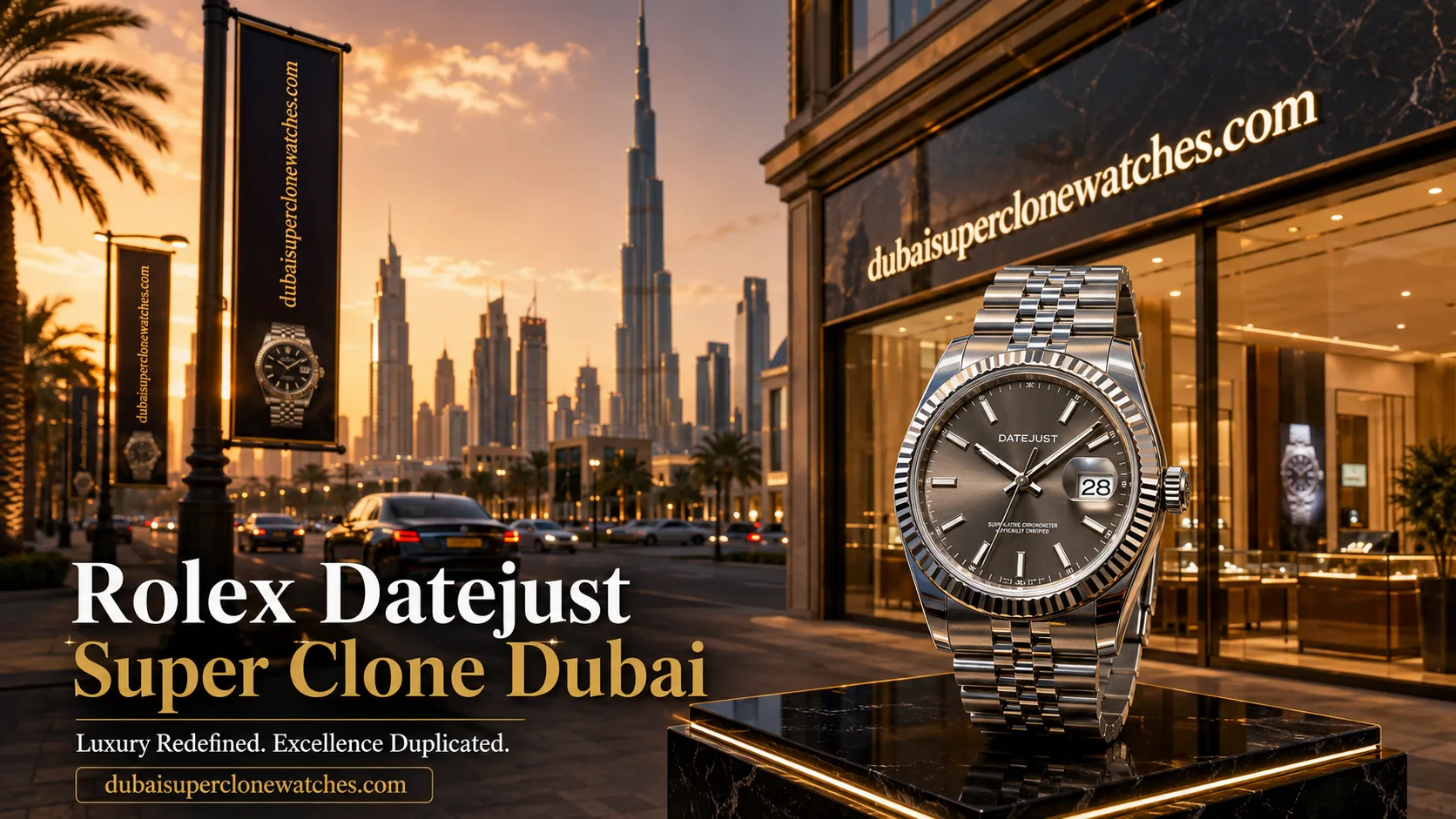
Dubai is internationally known for luxury shopping, premium jewellery, high-end fashion, and an active watch market. Alongside authentic luxury watches and legitimate pre-owned models, buyers may also encounter products advertised using terms such as “Rolex Datejust Super Clone Dubai,” “mirror copy,” “first copy,” or “AAA replica.” These descriptions can make a watch sound exceptionally close to an original Rolex, but they do not make it authentic.
A genuine Rolex Datejust is manufactured, assembled, tested, and documented according to the standards of the Rolex brand. A super clone or replica is produced by an unauthorised third party and normally carries design elements, logos, model references, or branding intended to imitate the original watch. Even when a replica appears convincing in photographs, important differences can usually be found in its movement, materials, finishing, serial information, bracelet construction, dial printing, water resistance, documentation, and long-term reliability.
This guide is intended to help Dubai watch buyers understand the difference between authentic, pre-owned, customised, homage, and counterfeit watches. It also explains the practical inspection steps buyers should take before making a substantial purchase.
What Does “Rolex Datejust Super Clone” Mean?
The term “super clone” is a marketing expression commonly used for a replica watch that is claimed to resemble an authentic model more closely than an inexpensive imitation. Sellers may claim that the watch has a high-grade automatic movement, sapphire crystal, stainless-steel case, accurate dial details, functional date display, or packaging similar to an original Rolex.
However, “super clone” is not an official Rolex product category. Rolex does not manufacture, approve, certify, service, or provide warranties for watches sold under this description. A product remains unauthorised regardless of how accurate its appearance may seem.
Buyers should also understand that descriptive phrases such as “Swiss movement,” “one-to-one quality,” “original specification,” or “master copy” do not establish authenticity. These terms are often used inconsistently, and two watches advertised under the same grade may have completely different components and quality levels.
Why the Rolex Datejust Is Frequently Copied
The Datejust is one of the most recognisable luxury watch designs. Its balanced dial, date window, Cyclops-style magnification, fluted or smooth bezel, distinctive bracelet options, and versatile appearance make it attractive to a wide range of buyers.
Because the design is well known, counterfeit manufacturers frequently reproduce visual elements associated with the collection. Commonly copied configurations include stainless-steel models, two-tone versions, diamond-style dials, Jubilee-style bracelets, Oyster-style bracelets, and popular dial colours.
The high demand for the Datejust also creates opportunities for misleading listings. A seller may use authentic Rolex photographs while delivering a different watch, mix genuine and non-genuine components, provide fabricated paperwork, or describe a replica as an authentic pre-owned piece.
Authentic Rolex, Customised Watch, Homage or Counterfeit?
These categories should not be confused.
An authentic Rolex Datejust is a genuine Rolex watch containing the appropriate original components, subject to any clearly disclosed service replacements or repairs.
A pre-owned Rolex Datejust is an authentic watch previously owned by another person. Its condition, service history, included accessories, and originality can vary.
A customised Rolex may begin as an authentic watch but include aftermarket diamonds, dials, bezels, bracelets, or other modified parts. Customisation can affect manufacturer servicing, value, originality, and resale demand. Every modification should be disclosed.
An homage watch takes general inspiration from a design style but should use its own brand identity and should not display counterfeit Rolex trademarks, logos, reference numbers, or documentation.
A counterfeit or super clone watch imitates Rolex branding without authorisation. It may reproduce the crown logo, dial text, case markings, warranty card, serial number, packaging, or model reference to appear authentic.
Examine the Seller Before Examining the Watch
The seller is one of the most important parts of any watch transaction. Before discussing price, ask for the legal business name, physical location, invoice policy, return terms, authenticity guarantee, and warranty conditions.
A trustworthy seller should clearly state whether the watch is authentic, customised, pre-owned, aftermarket, homage, or replica. Avoid sellers who provide vague answers, refuse independent inspection, pressure you to pay immediately, or claim that authentication is unnecessary.
Buyers should be cautious when a seller communicates only through disappearing messages, requests payment to an unrelated account, refuses to issue an invoice, or changes the watch description during the conversation.
Check the Dial Carefully
The dial is one of the first areas examined during professional authentication. On an authentic luxury watch, printing, spacing, alignment, markers, hands, and finishing should be precise.
Look closely at the brand name, crown logo, minute track, model text, hour markers, date window, and luminous material. Warning signs can include uneven lettering, incorrect fonts, inconsistent spacing, crooked markers, rough edges, paint overflow, dust beneath the crystal, or poor alignment.
A high-quality counterfeit may look convincing without magnification, so visual inspection alone is not enough. Compare the specific configuration with verified references for the claimed model and production period.
Inspect the Date Display and Magnification
The date feature is central to the Datejust design. Counterfeit watches frequently show weaknesses in date alignment, font shape, magnification, and date-change operation.
The numeral should sit correctly within the window and remain properly aligned throughout the calendar cycle. Poorly printed numerals, inconsistent positioning, weak magnification, distortion, or a slowly dragging date change can indicate a low-quality mechanism or incorrect components.
However, buyers should not rely on one feature as definitive proof. Counterfeit manufacturers continually improve visible details, while authentic watches can also show wear, damage, or replacement components.
Evaluate the Case and Bezel
Case dimensions, lug shape, polishing, brushing, bezel profile, crown construction, and overall finishing should be assessed together.
Counterfeit cases may feel too sharp, too thick, too light, or incorrectly proportioned. The transition between polished and brushed surfaces may appear uneven. The bezel may lack the crispness, reflectivity, or symmetry expected from a properly manufactured luxury watch.
Check for signs that the case has been excessively polished. Heavy polishing can soften edges and change the original geometry even when the watch itself is authentic. This can affect collectability and resale value.
Inspect the Bracelet and Clasp
The bracelet often reveals differences that photographs conceal. Examine the link finishing, articulation, end-link fit, clasp operation, engravings, screws, and overall solidity.
A counterfeit bracelet may rattle excessively, show rough internal edges, have inconsistent gaps, or use shallow and poorly executed engravings. The clasp may feel loose or require unusual force to open and close.
An older authentic bracelet may naturally show stretching or wear, so age and condition must be considered. The question is not simply whether the bracelet feels new, but whether its construction matches the claimed model and production period.
Do Not Depend Only on Weight
Many buyers assume that a fake watch will always feel significantly lighter. This is unreliable. Modern replicas can use heavier metals, weighted components, and solid bracelets to imitate the mass of an original.
Weight can support an assessment when compared with verified specifications, but it cannot prove authenticity on its own. Differences may also result from bracelet sizing, aftermarket parts, case materials, or modifications.
The Movement Is a Critical Authentication Point
The internal movement is often one of the strongest indicators of authenticity, but opening a watch should be performed by a qualified professional using appropriate tools.
Counterfeit movements may be decorated to resemble genuine calibres, and some may copy the visible architecture of authentic movements. Nevertheless, differences can often be found in finishing, component layout, regulation, engravings, balance construction, rotor design, date mechanism, and serviceability.
A seller should not object to an independent movement inspection when a watch is represented as authentic and the buyer is prepared to cover reasonable inspection costs.
Serial Numbers and Reference Numbers
Serial and reference information should correspond with the watch’s claimed model, configuration, approximate production period, and documentation.
A visible serial number does not automatically prove authenticity. Counterfeit watches may reuse numbers taken from genuine listings or repeat the same number across multiple units.
Inspectors should check the quality, position, depth, style, and consistency of the markings. The numbers should then be compared with the watch configuration and supporting records.
Never publish a complete serial number in a public advertisement. Exposing it may allow unauthorised parties to copy it for another counterfeit product.
Boxes and Papers Can Also Be Counterfeit
Packaging, tags, booklets, receipts, and warranty cards can create a strong impression, but counterfeit accessories are widely available. A complete-looking set is not necessarily an authentic set.
Check whether the watch details match the card, invoice, reference, serial information, dial, bracelet, bezel, and approximate production date. Misspellings, poor printing, incorrect fonts, low-quality materials, inconsistent dates, or mismatched information should be investigated.
An authentic watch sold without its original box may still be genuine. Conversely, a counterfeit watch presented with convincing packaging remains counterfeit.
Ask for an Independent Authentication
For a high-value watch transaction in Dubai, independent authentication is one of the most sensible precautions.
Choose a qualified watchmaker, recognised authentication service, established auction specialist, or reputable dealer that is independent of the seller. The inspection should assess the external components, movement, reference information, originality, condition, modifications, and potential service requirements.
Ideally, the invoice should state that the sale is conditional on successful authentication. Buyers should retain copies of the listing, seller messages, payment record, invoice, authentication report, and watch photographs.
Understand the Difference Between Authenticity and Condition
A watch can be authentic but still be a poor purchase. It may require expensive servicing, contain damaged components, have water ingress, show excessive polishing, include aftermarket parts, or have an unclear ownership history.
Ask when the watch was last serviced, who performed the service, which parts were replaced, whether it was pressure-tested, and whether documentation is available.
A proper evaluation should answer two separate questions:
- Is the watch authentic?
- Is the watch in a condition that justifies the asking price?
Be Careful With Prices That Appear Unrealistic
A substantially below-market price should lead to more verification, not faster payment. Sellers may create urgency by claiming that the price is available for one day, that another buyer is waiting, or that the watch comes from a distressed sale.
Price differences can be legitimate because of condition, age, missing accessories, service needs, modifications, or seller circumstances. However, every major discount should have a clear and verifiable explanation.
Research comparable authentic watches with the same reference, approximate year, material, dial, bracelet, condition, and included accessories. Comparing unrelated configurations can produce misleading conclusions.
Online Photographs Are Not Enough
Images can be edited, reused, or taken from another seller. Request current photographs and videos showing the actual watch, date, time, serial area with sensitive digits concealed, clasp, bracelet, case sides, crown, dial, and movement inspection where appropriate.
A useful verification method is to ask the seller to photograph the watch beside a handwritten note containing the current date and a unique phrase. This helps confirm that the seller physically possesses the watch, although it does not prove authenticity.
Complete the final inspection in person or through a trusted independent professional whenever possible.
Request a Detailed Invoice
A professional invoice should clearly describe what is being sold. It should include the business details, watch brand, model, reference, partial serial information, condition, included accessories, disclosed modifications, warranty terms, return conditions, amount paid, and payment method.
The invoice should not use ambiguous descriptions that could allow an authentic watch claim to be replaced later with a replica or “inspired” product description.
For a replica or homage product, the invoice and advertisement should never misleadingly describe it as an original Rolex.
Water Resistance Claims Require Testing
Do not assume that a watch is water-resistant because it has a screw-down crown or because the seller states a depth rating.
Gaskets deteriorate, cases can be opened incorrectly, crystals may be replaced, and counterfeit watches may never have been properly sealed. Even an authentic watch should be pressure-tested after servicing or before exposure to water.
Avoid swimming, showering, or submerging an unverified watch.
Consider Servicing and Spare-Part Availability
An authentic luxury watch is designed around a long-term service ecosystem, although servicing costs and component replacement policies must still be considered.
Replica movements may be difficult to repair because replacement parts, technical documentation, and skilled servicing may not be consistently available. Some repair professionals will decline to work on counterfeit products.
A low initial price can therefore be offset by short lifespan, poor timekeeping, moisture damage, unavailable components, or the need to replace the entire movement.
Common Warning Signs in Dubai Watch Listings
Buyers should investigate listings that use phrases such as “exactly like original,” “cannot be detected,” “customs-safe,” “original box and card included” without proof, or “same factory as genuine.”
Other warning signs include copied photographs, inconsistent descriptions, hidden business identities, refusal of inspection, cash-only demands, changing prices, pressure tactics, and claims that authentication professionals will not be able to detect the watch.
No responsible seller should promise that a counterfeit product is indistinguishable from an authentic watch.
Final Buyer Checklist
Before purchasing any watch represented as an authentic Rolex Datejust in Dubai, confirm the seller’s identity, obtain a written description, inspect the dial and case, verify the bracelet, check the reference and serial information, review the documentation, examine the movement, compare market pricing, request independent authentication, and obtain a detailed invoice.
Do not treat packaging, weight, photographs, or one visible feature as conclusive proof. Authentication requires the complete watch to be evaluated as a system.
Searches for “Rolex Datejust Super Clone Dubai” often lead buyers to products presented as highly accurate alternatives to authentic luxury watches. The terminology may sound premium, but it does not establish authenticity, brand approval, investment value, or long-term reliability.
Buyers seeking an authentic Rolex Datejust should prioritise provenance, professional authentication, transparent documentation, condition assessment, and a seller willing to provide clear written guarantees. Those considering an homage-style watch should select products carrying their own legitimate brand identity rather than counterfeit Rolex trademarks.
Careful verification protects more than the purchase price. It helps buyers avoid misleading descriptions, poor-quality components, fabricated documents, expensive repair problems, and future resale disputes.